|

|
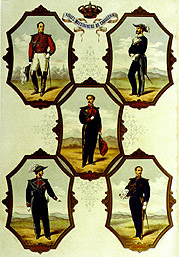
Uniforms
of the Reales Maestranzas de Caballería of
Ronda, Seville, Granada, Saragossa and Valencia.
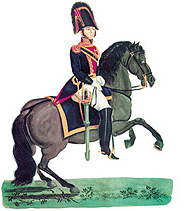
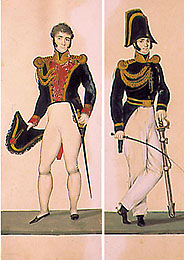
RMR
Uniforms Treatise
Watercolour, 19th century.
|
(According to the uniforms instructions booklet
of the Real Maestranza de Caballería of Ronda)
Full
Gala
Riding suit
Riding jacket
with epaulettes and laces, bandolier, braces and sable,
sable-holder or clasp, tightly fitting white suede trousers,
knee-high boots with spurs, hat with white feather and leather
gloves. The wearer´ s full collection of medals and
crosses should be worn with this uniform.
Occasions
on which the uniform should be worn
a.Greeting or bidding farewell to the King and Queen.
b.Official days and birthdays of the King and Queen and
attendance at royal audiences on those days.
c. Royal weddings, receptions, banquets and dinners at court.
d.Official religious functions attended by the King and
Queen.
Royal funerals.
e.Gala functions at theatres attended by the King and Queen.
Gala
Riding jacket with epaulettes and laces, bandolier,
braces and sable with clasp, long trousers, white leather
gloves, patent leather one-piece boots with fixed spurs,
hat with crest.
The wearing of crosses is recommended.
Occasions
on which the uniform should be worn
a.Audiences with the King and Queen and the crown princes
and princesses.
b.Greeting or bidding farewell to the crown princes and
princesses.
c.Official days and birthdays of the crown princes and princesses,
and attendance at royal audiences on those days.
d.Feast days of the patron saints of Spain, and attendance
at religious services on those days.
e.Corpus Christi and Holy Thursday, when the King and Queen
are not in attendance. Evening receptions, official dinners
and balls, gala events at theatres when the King and Queen
are not in attendance.
f.Whenever the King and Queen are in attendance at any of
the above-mentioned events, full gala uniform should be
worn. .
Semi-Gala
Riding jacket with epaulettes and laces, bandolier, sword
but neither clasp nor sable-holder, long trousers, patent
leather one-piece boots with fixed spurs, white leather
gloves, hat with neither feather nor crest. The wearing
of crosses is optional
Occasions
on which the uniform should be worn
a.Official days and birthdays of non-succeeding princes
and princesses.
b.Greeting or bidding farewell to non-succeeding princes
and princesses.
c.Greeting or bidding farewell to official commissions or
dignitaries such as Ministers, Ambassadors, Grandees, etc.
d.Good Friday, unless the King and Queen are in attendance,
when full gala uniform is required.
e.Burials or funeral services of dignitaries.
f.Attendance at official military events and those organised
by the Madrid noble order.
g. Garden parties attended by the King and Queen or their
guests.
Daily
uniform
Jacket buttoned to the neck, long trousers,
sword but no clasp, hat without crest, white leather gloves
and black one-piece boots with fixed spurs. The wearing
of crosses is discretionary but large crosses should preferably
not be worn.
Occasions
on which the uniform should be worn
Occasions on which the uniform should be worn
Formal
dress
Jacket with cuffs, sword with or without clasp,
white scabbard, knee length white woollen breeches, plain
white silk stockings, patent leather shoes
with gold buckles, hat without crest and white kid gloves.
All crosses and medals should be worn.
Occasions
on which the uniform should be worn
Official and society balls where uniform is required and
for court balls.
Short
cloak
This is the order´s only coat and may be worn
as required by members, except for group events where other
members are not wearing it.
|


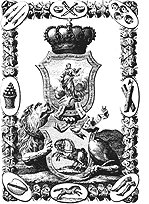 Since
its inception the Maestranza has used its own coat of arms: in
the stamps held by the registry for titles and letters, with the
motto Regales.
Equestris. Ordo. Civitas. Arundensis. Securitas. Baeticae;
and on the flags of its bugles, repositories and elsewhere. Its
coat of arms was represented by two Spanish horses, equipped with
bit and full tack, running together across a golden field, with
the motto Pro Republica ets dum ludere videmur, whilst the shield
rested on two diagonal lances and was framed by various associated
instruments. These symbols were intended by the founders to express
the heroic design that underpinned the establishment of the Maestranza.
The two horses signify nobility united, neither indomitable nor
free, as some republics have represented it, but obedient and
smartly attired, as symbolised by the masterly and bit-equipped
horse. Similarly, nobility is ready and willing to serve sovereign
and country, as signified by the fully equipped state of the horse
and the dominant theme of the motto.
Since
its inception the Maestranza has used its own coat of arms: in
the stamps held by the registry for titles and letters, with the
motto Regales.
Equestris. Ordo. Civitas. Arundensis. Securitas. Baeticae;
and on the flags of its bugles, repositories and elsewhere. Its
coat of arms was represented by two Spanish horses, equipped with
bit and full tack, running together across a golden field, with
the motto Pro Republica ets dum ludere videmur, whilst the shield
rested on two diagonal lances and was framed by various associated
instruments. These symbols were intended by the founders to express
the heroic design that underpinned the establishment of the Maestranza.
The two horses signify nobility united, neither indomitable nor
free, as some republics have represented it, but obedient and
smartly attired, as symbolised by the masterly and bit-equipped
horse. Similarly, nobility is ready and willing to serve sovereign
and country, as signified by the fully equipped state of the horse
and the dominant theme of the motto. 
