
|
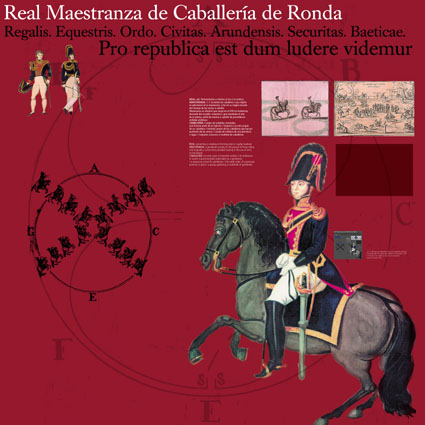
«Since the Middle Ages, the leadership of armies and the use of weapons were tasks that fell to the nobility. In the military and political history of Andalusia, and, naturally, of Spain as a whole, a very important role was played not only by the military corps but also by fraternities, maestranzas (royal fraternities of noblemen) and other chivalric orders. These were created by the Crown as a means of encouraging the local nobility to train as horsemen and to use weapons, and therefore to be ready to respond immediately to the call of the king and present themselves wherever they were needed. In the case of Ronda, Philip II merely sanctioned and encouraged a practice that was already in existence. It is known for example that the military corps of the Nobility of Ronda had already fought in 1569 in the war against the Moors, that is before the Royal Decree of 6 September 1572 and the foundation of the Maestranza. This decree also demonstrates the king´s strong recommendation that noblemen train for war through tournaments, equestrian games, shot-put contests, gymnastic rings and, last but not least, the spearing of bulls. Confrontation with bulls was not only an element of equestrian training but also a popular spectacle. Several years later, in 1575, the Maestranza de Ronda received instructions from Philip II for its members to take pains to breed «good horses for the protection and defence of the kingdom». Despite the advent of state-financed and state-controlled armies in the countries of the new Europe, the military corps of the Real Maestranza de Ronda never completely abandoned its preparations for war, as was demonstrated when it united with other patriotic forces to combat the invasion of Napolean Bonaparte. After ending its historical commitments to the army, the Ronda Maestranza maintained its riding school and channelled its energies into cultural and charity activities. The Ronda maestrantes have therefore had been confronting bulls for centuries, spearing them with lances and «if required as a matter of honour, even fighting them on foot, face to face, and killing them by the sword». These age-old games with bulls sowed the seeds in Ronda for a tauromachy with both noble and popular appeal, and in turn paved the way for modern bullfighting on foot. The extraordinary fact that the two most important bullfighting dynasties of all times - the Romeros and the Ordóñez - were born in Ronda, can only be attributed to the existence of an institution such as the Real Maestranza de Caballería de Ronda.» Pedro Romero de Solís
|
 |
 |
|