
«Since
the Middle Ages, the leadership of armies and the use of weapons
were tasks that fell to the nobility. In the military and political
history of Andalusia, and, naturally, of Spain as a whole, a very
important role was played not only by the military corps but also
by fraternities, maestranzas (royal fraternities of noblemen)
and other chivalric orders. These were created by the Crown as
a means of encouraging the local nobility to train as horsemen
and to use weapons, and therefore to be ready to respond immediately
to the call of the king and present themselves wherever they were
needed. In the case of Ronda, Philip II merely sanctioned and
encouraged a practice that was already in existence. It is known
for example that the military corps of the Nobility of Ronda had
already fought in 1569 in the war against the Moors, that is before
the Royal Decree of 6 September 1572 and the foundation of the
Maestranza. This decree also demonstrates the king´s strong
recommendation that noblemen train for war through tournaments,
equestrian games, shot-put contests, gymnastic rings and, last
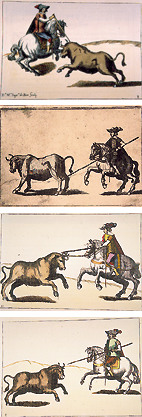
but not least, the spearing of bulls. Confrontation with bulls
was not only an element of equestrian training but also a popular
spectacle. Several years later, in 1575, the Maestranza de Ronda
received instructions from Philip II for its members to take pains
to breed «good horses for the protection and defence of
the kingdom». Despite the advent of state-financed and state-controlled
armies in the countries of the new Europe, the military corps
of the Real Maestranza de Ronda never completely abandoned its
preparations for war, as was demonstrated when it united with
other patriotic forces to combat the invasion of Napolean Bonaparte.
After ending its historical commitments to the army, the Ronda
Maestranza maintained its riding school and channelled its energies
into cultural and charity activities. The Ronda maestrantes have
therefore had been confronting bulls for centuries, spearing them
with lances and «if required as a matter of honour, even
fighting them on foot, face to face, and killing them by the sword».
These age-old games with bulls sowed the seeds in Ronda for a
tauromachy with both noble and popular appeal, and in turn paved
the way for modern bullfighting on foot. The extraordinary fact
that the two most important bullfighting dynasties of all times
- the Romeros and the Ordóñez - were born in Ronda,
can only be attributed to the existence of an institution such
as the Real Maestranza de Caballería de Ronda.»
Pedro
Romero de Solís
The
Reales Maestranzas de Caballería
(royal fraternities of noblemen) emerged between the 16th and
19th centuries. The first of these aristocratic institutions was
founded in Ronda in 1572, whilst the last to be established was
the Saragossa fraternity in 1824. The Seville, Granada and Valencia
fraternities all emerged during the 17th century.
The term maestranza first appeared in Andalusia in the mid-17th
century as a derivative of maestro, meaning teacher of the art
of gineta, an Arabic-Andalusian style of horse riding. By extension
the term was used to describe a group of noble individuals trained
in the skill of horse handling. Like the fraternities of noblemen
and warriors who trained to be fit and ready to defend frontiers
during the Reconquest and to defend the king, it was a typical
medieval institution.
The origin of the Ronda fraternity is a royal letters patent dated
6 September 1572 by Philip II, which encouraged that «...
in the cities, towns and places of these kingdoms, the noblemen
and other leading gentlemen found and create fraternities, companies
or orders, devoted to a specific saint, with statutes, conditions
and chapters regarding, amongst other things, the celebration
on certain days of jousts, tournaments, equestrian games and other
military exercises».
The monarchs distinguished these institutions with a series of
privileges, especially during the 18th century. For example, Philip
V decreed that every such institution would always have as its
president a member of the royal family, and after a certain period
of time, this would be the king himself. Each institution had
its own uniform and the capacity to organise bullfights.
Regarding the particular history of the Real Maestranza de Caballería
de Ronda, the following are key periods in its history:
|
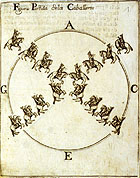
Chivalric
treaty. Tapia and Salcedo
Columbian Library, Seville
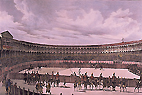
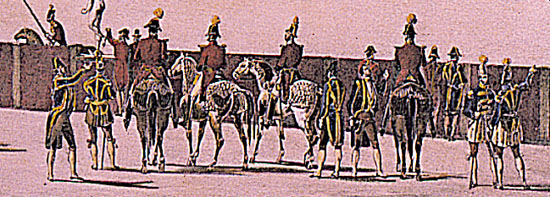
Jousting
by the Reales Maestranzas for the swearing in of Isabella
II as the crown princess.
Lithographs by P. Blancharz, 1834.
|
1525-1705.
The royal letters patent by Philip II was read in Ronda at the
town council meeting of 22 September 1572. On behalf of the
town, the mayor and other noblemen present engaged in the typical
ritual of removing their hats, taking the king´s letter
in their hands, kissing it and placing it on their heads as
a sign of compliance. In addition to agreeing to alert all those
noblemen not present, it was decided that the first step would
be to clean the public thoroughfare of the Plaza del Pozo and
purchase a jineta lance and a few bells so that on feast days
any number of horses might be able to run.
The year 1573 marked the constitution of what would later become
the Maestranza: the Cofradía del Santo Espíritu
(Fraternity of the Holy Spirit). According to the statutes,
equestrian festivities were to take place on «the second
day of the Holy Spirit, on the feasts of St John and St Peter,
during Carnival and on Easter Sunday, and each Thursday the
sons of noblemen were to ride in the Plaza del Pozo, their patron
saint being Our Lady of Grace». There were also statutes
regarding horse breeding and maintenance in Ronda, these being
amongst the earliest tasks adopted. During this period it was
«an educational institution, a genuine school of military
instruction, whose ethos was rooted in the gallant arts of horse
riding and fencing, for demonstration on specific public holidays,
and the practice and designation of which represented its first
and only statutes». (Juan Pérez de Guzmán,
La Casa del Rey Moro, Madrid, 1920)
1706-1750.
The emergence in several cities of noble corps during
the last third of the 17th century, and the acceptance of the
term maestranza to designate these corps, eventually led to
a new name for the former Fraternity of the Holy Spirit. Whilst
the means and ends remained unchanged, the internal organisation
was adapted to meet the new needs of the times.
At an historic meeting held on 17 October 1706 at the church
of Our Lady of Grace the order gained independence from the
town council and admitted new members ready and willing to serve
the king. Important historical circumstances of this period
were the War of Succession (1701-1730), with the loss of Gibraltar,
the defence of the coastlines and the prerogatives granted in
1730 to the Maestranzas by Philip V and ratified by Ferdinand
VI. It was at this point that the name Real Maestranza de Caballería
de Ronda was adopted.
1750-1850.
This period is considered to be the most brilliant in the history
of the order. Two factors stand out: the social phenomenon of
the nobility, and, following the construction of the bullring,
the boom in tauromachy. Membership of the Maestranza increased
and horse breeding was established, this initiative nevertheless
being brought to a halt by the War of Independence. The statutes
were written and the so-called Academy of Lesser Sciences was
created and run for a time for the sons of members.
Jousts and tournaments were transferred from the Carrera del
Pozo to the Plaza de Santa María la Mayor. Depending
on the type of festivity held in the square, presided over by
a portrait of the king or prince, on completion of the games
thanks would be given to the patron saint, Our Lady of Grace,
at the nearby chapel devoted to her. The event would be rounded
off with refreshments for the members at the home of the Deputy
President. These were reportedly very gay occasions and there
would be dancing until dawn.
During this period the Maestranza was directly affected by a
number of important events, such as the War of Independence.
Following the abdication of Charles IV, the Maestranza officially
marked the accession to the throne of his son Ferdinand VII
with a series of magnificent events. The four existing Maestranzas
were called upon to exhibit their skills for the impending meeting
between the King and Napoleon I. Nevertheless, the popular rising
against the French troops on 2 May prevented this demonstration
from taking place and led to the creation of the Maestranza´s
own batallion, which participated in the battle of Almonacid.
1850-2000.
The Maestranza de Caballería de Ronda has survived intact
to the present day and has increased its work in its home town
in the form of donations and grants for public works, health
and other issues, as well as allowing its premises to be used
for multiple purposes. Its main functions are the maintenance
of the bullring and its contribution to social and cultural
works.
|
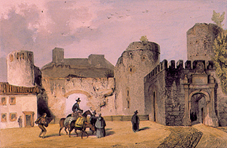
The walls of Ronda.
Lithograph by D. Robert, 1835.From
the book «L´Espagne pittoresque, artistique
et monumentale». Ronda.
|
Ronda.
A brief history
Ronda likes
to think of itself as the divine city, in the words used to describe
it by the poet Rainer María Rilke. Set on a Miocene plateau
more than 700 metres above sea level, it is separated from the
coast by rugged topography and has a severe climate. It is surrounded
by Jurassic mountain ranges and sits amidst a collection of Natural
Parks and protected spaces: Cartajima to the south; Sierra de
las Nieves to the east, the highest peak of which is the Torrecilla
at 1.919 m.; Castillejos and Líbar to the west; and a group
of hills extending to north. The river Guadalevín, called
Wadi L-Laban by the Arabs and meaning «river of milk»,
is a tributary to the left side of the Guadiario and divides the
town into two from south-east to north-west, generating a gorge
more than 90 metres deep. This geographical accident is one of
the town´s most recognisable characteristics.
Arunda, close to Acinipo and mentioned by Pliny, has traditionally
been identified as the present-day Ronda. In reality, during Roman
times the site was nothing more than a small settlement. It was
during the Islamic period that it began to acquire importance
as the head of the Takurunna province, with the first settlers
being of Berber origin. Various sources mention several Berber
families of the Takurunna district, such as the Banu Jali, who
supplied 400 horsemen to Abd al-Rahman I shortly after his arrival
in the Iberian peninsula, and others who integrated with the Umayyad
state from the earliest days. This was the region of the ancestors
of the famous Umar ibn Hafsún, the Muwallad of Bobastro
who rebelled against the central power of Córdoba, warring
with two emirs and the first Spanish caliph, Abderramán
III. According to the chronicles, by the 10th century Ronda was
already a «very strong and very ancient» settlement.
There is nevertheless much doubt surrounding the exact site of
what is today known as Ronda. According to one 13th century author,
there were three centres of population in the Ronda region: a
town called Takurunna, the fortress of Ronda (Runda) and the castle
of Onda (Unda).
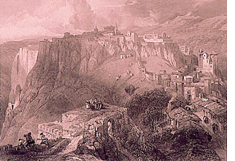
Lithograph by Pannemaker,
1848. From the book «L´Espagne pittoresque,
artistique et monumentale». Ronda.
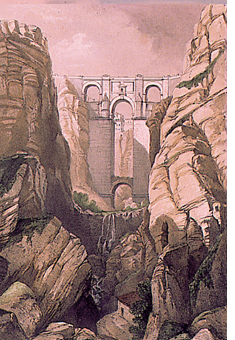
Litografía
de D. Robert,
1835. Del libro «L´Espagne pittoresque,
artistique et monumentale».
|
The dissolution
of the Caliphate of Córdoba and the subsequent emergence
of a system of small constantly warring independent kingdoms,
the so-called taifas, precipitated the fall of Ronda into the
hands of King al-Mutadid´s Sevillians and gave rise to numerous
poems about it being an impregnable town. Subsequently it became
part of the Almoravid and Almohad empires. It was under the latter
that Ronda began to adopt the true traits of a town, having more
in common with the Nasrid developments that were to emerge in
the 16th century than with the simple centres of refuge of earlier
centuries. During the early Nasrid reign of Granada, Ronda was
granted to the Marinîds in return for their support, until this
Mahgrebi dynasty was swept from al-Andalus by Castilian victories.
Mohammed V was later to use Ronda as the base for his fight to
recover the throne of Granada. During the 15th century the people
of Ronda were attacked by Christian troops and on 22 May 1485,
greatly aided by the novel use of artillery, the town was taken
by King Ferdinand. This moment is illustrated in one of the bas-reliefs
of the choir stalls in the cathedral at Toledo.
The
geological conditions that made Ronda inaccessible also made it
a unique place in Europe, and it is this circumstance that has
traditionally obstructed its urban expansion, surrounded as the
town is by the Guadalevín, the Culebras stream and the
imposing precipice to the north. Judging from the words of an
anonymous traveller, the place had a poor reputation during the
11th century: «It is a town that bears the mark of savagery,
constantly prey to the most disagreeable severity / Those who
have visited it once have never had the slightest inclination
to go back / The horizon is always shrouded in mist and the main
square fills one´s heart with sadness». Nevertheless,
one century later, Prince Ismail Imad ab al-Ayyubi´s description
was: «Ronda has a most formidable and elevated castle, which
the clouds crown in the form of a turban and appear to drape with
double necklaces of varied pearls». Expansion to the eastern,
western and southern hills took place during the 13th century.
During the reign of the Marinîds in the following century, several
improvements were introduced and the town gained new buildings
under the instruction of the Sultan Abú l-Hassan, whose
son Abd el Malik, known as Abomelic, had proclaimed himself king
of Ronda, Algeciras and Gibraltar.
During his reign, the court at Madina Runda was made up of well-known
philosophers, poets and intellectuals, and the town became a busy
trading centre whose shops and warehouses boasted the most sophisticated
merchandise from Morocco, Asia and Spain. Well-guarded fortresses,
high towers and abundant wells and houses were built to be subsequently
inherited by the Castilian conquerors, who transformed the churches
and turned the houses into mansions.
The growth during the 18th century of the Mercadillo shantytown
necessitated two monumental works to save the town. The second
of these, the monumental bridge over the gorge, the Puente del
Tajo, which links the old part to the new part, still remains.
The present-day town contains the following three districts: the
Mercadillo (lit. Street market), where the enlightened rationalism
of Charles III is evident; the Ciudad (the town), taking in the
Arabic medina, the most noble part; and the district of San Francisco
situated on the other side of the old fortress walls and inhabited
by different types of farm workers.
In the 19th
century Ronda remained an isolated mountain town until being discovered
by foreign travellers at the height of the Romantic period. Banditry
and smuggling, which had always prospered in the precipitous topography
and which fed on the circumstances of the War of Independence
against the French army, became in travel literature a quasi-commercial
brand. Merimée, Ford, Gautier, Davillier, as well as the
drawings by Lewis, Roberts, Blanchard and Doré, have created
an image of Andalusia in general and of Ronda in particular in
which the bandit, mountain maiden and brave bullfighter go hand
in hand. As one sets out on a stroll through Ronda, it is as well
to remember that behind this typical postcard scene is a rich
and complex history, a large part of which stems from its Arab
past and the modernity that came with the Enlightenment.
|