|


|
|
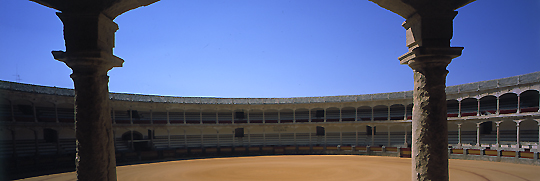
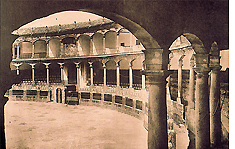
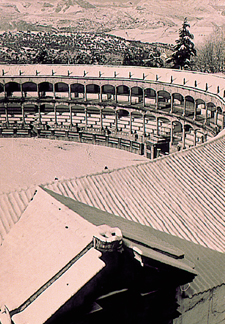
The Ronda
bullring is owned by the Real Maestranza de Caballería
of Ronda and, due to its vital role in the history of bullfighting,
is one of the most important monuments in Andalusia. The legend
of this severe and impressive ring is a constant feature in the
evolution of the art of bullfighting, whilst its architecture
continues to fascinate those who have the opportunity to visit
it.
The
history of its construction
The definitive consolidation of bullfights as essentially popular
events dates back to the reign of Philip V and they were further
consolidated as such during the 18th century. Bullfighting became
a professional activity and increased the need for enclosed spaces
with capacity for fee-paying spectators to finance the costs.
It was at this time therefore that the first independent rings
emerged. In their construction of bullrings, the Reales Maestranzas
played a key role in establishing a series of aesthetic rules
that were to become the architectural model. Of the five Maestranzas
(Ronda, Seville, Granada, Valencia and Saragossa), the three situated
in Andalusia built their own bullrings. The construction of the
Ronda bullring came about due to interest on the part of the Maestranza
but also due to a longstanding tradition of bullfighting. The
town already had spaces which were habitually used for bullfights,
and these spaces were also used by the Real Maestranza for its
own activities. Plaza del Pozo, with the patron saint of the Maestranza
(Our Lady of Grace), in the main square of the San Francisco district,
which for a long time was situated on the outskirts of the town.
Plaza del Campillo, situated on the edge of the gorge with a backdrop
of the Colegio de Santa Teresa, formerly the palace of the Marqueses
de Moctezuma. Plaza Mayor, where the continuous balcony of the
collegiate church of Saint Mary was used as the platform for the
authorities and other important people. This balcony was added
to the church in the late 16th century. The uniqueness of Ronda
lies in the fact that bullfights were transferred directly from
the Plaza Mayor to a purpose-built bullring on the outskirts of
the town, omitting the interim phase of a provisional ring made
from wood, as was the case elsewhere.
|
|
1754.
On 14 January the Real Maestranza requests approval from the Marqués
de la Ensenada to build a bullring. On 23 January, a joint application
is made with the town council to Charles III. A site is designated,
«which is called Hollanquilla, some 82 yards from the gorge».
1769. Agreement with the town council for the use of
the land.
1767 (?). The request is turned down by the court,
which proposes that the bullring be erected from wood for use
during fairs and then dismantled on completion of the festivities.
1779. In all likelihood this is the date the
Real Maestranza commenced construction works, without waiting
for the relevant permission. The site was probably used that same
year. In June the institution reports an official request from
Francisco de Almagro, the master builder, for permission to undertake
the construction of the ring himself, suggesting that the works
were proceeding very slowly.
1780-1781. Fund-raising by 86 maestrantes, resident
in Ronda and other parts of Spain, with contributions ranging
from 750 to 1.500 reales.
1782. The ring is used on 24 and 25 May for bullfights
by Pedro Romero and his brother José, as well as for a
primitive type of shot-put contest organised by the Order with
the participation of the troops. According to the Maestranza accounts,
27 people were paid, including «ticket collectors»,
«ushers» and «bottle collectors». At the
end of the year, with the works still underway, the master stonemason
Antonio Guerrero submits an invoice for the construction of 72
pillars, 72 arches, 250 yards of cornice, 2 small pillars and
«detailed work on nine of the above-mentioned pillars».
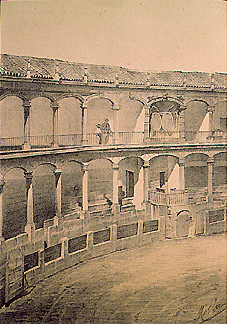
The construction really gets underway during this year. A document
held by the Institution and significantly entitled La Obra (The
Works) specifies the sum expended to date as 87.703 reales. The
largest item of expense is on staff: builders, labourers and skilled
workers, such as the stonemasons from Cabra and the quarry workers
from Teba.
|
|
1784.
A decisive year in the history
of the ring with bullfights already taking place despite the works
still being incomplete. Certain bullfights were to feature Pedro
Romero and Pepe Hillo, the post of Deputy President of the Maestranza
at the time being held by José Moctezuma. On 11 May, the
date of the first bullfight of the fair and a gala event organised
by the Real Maestranza in honour of the birthday of Prince Gabriel,
proceedings were just getting underway around half past three
in the afternoon when, in an incomplete section of the ring that
had been occupied by the general public, a soldier of the Provincial
army, called Isidoro Espinosa, moved a pillar and caused the partial
collapse of the bullring. By all accounts the section supported
by 16 arches fell to the ground. According to one eye-witness
report, «The general cries of the audience were silenced
by the terrible thunder of a large part of the ring collapsing.
The sixteen main balconies were the first to fall, causing the
audience to flee in fright, some to seek help and others for fear
of death. All was chaos, lamentation and grievous moans. People
were scared of staying there and crowded the gates to get out,
whilst at the same time others tried to get in. The priests came
with holy oil and the viaticum, the bells rang out, whilst thousands
attempted to free from the rubble their injured or dead parents,
brothers, sisters and other relatives». The person who allegedly
caused the collapse lost his life along with ten other people.
1785. The unfortunate incident had serious consequences.
For a time bullfights were expressly prohibited and permission
to complete the bullring was suspended. This suspension was only
raised in January 1785 following numerous efforts. Reconstruction
commenced under the direction of the same master builder, Francisco
de Almagro, with Juan de Lamas as the master stonemason and a
skilled builder called Antonio Ordóñez. On 26 April
of the same year the Real Maestranza writes to the king informing
him of the completion of the works. The bullring is officially
opened on 19 May 1785, 300 years after the occupation of Ronda
by King Ferdinand. Presided over by Bartolomé Félix
de Salvatierra, Deputy President of the Maestranza Fraternity,
on behalf of the President of the Brotherhood, Prince Gabriel
Antonio, the son of Charles III and Maria Amalia of Saxony, the
event is massively attended by the general public with 126 noblemen,
together with the maestrantes and other authorities, in the boxes
for distinguished guests. On 9 November 1785 Charles III prohibits
all bullfights with certain public exceptions. This ruling does
not affect the events at the Maestranza bullring, where bulls
continue to run, generally on two separate occasions
1788. The main gate, built by the Ronda stonemason
Juan de Lamas, is completed. In May of the same year there were
approximately 600 people putting the final touches to the bullring.
1797. Slightly later than at other Maestranzas, permission
is received to hold public and charity bullfights at the Ronda
bullring.
1810.The French troops use the bullring as their garrison.
1813. Agreement
is reached to carry out repairs to the bullring, «almost
completely destroyed by the French».
|
|
1820. At a bullfight during the first
year of the Liberal Triennium, the only death in the history of
the bullring occurs. Francisco Herrera, «Curro Guillén»,
is gored by a bull from the Cabrera ranch in Utrera. Legend has
it that he was buried next to the pens. His remains were subsequently
found whilst repair works were being carried out. During the 19th
century the most common bullfights are those held in aid of fraternities.
Amateur bullfights and those using young bulls are organised by
the town council in the bullring loaned for the purpose by the
Maestranza. Despite the lack of top-league bullfights, the Ronda
bullring nevertheless sees the finest figures due to the reputation
enjoyed by the Maestranza as the leading such institution. These
figures include Pepete and Gordito, Curro Cúchares, Guerrita,
Reverte, Mazantini, Caraancha, Espartero, Frascuelo, Antonio Fuentes
and Bombita. At the dawn of the 20th century Ronda sees two great
figures become fully fledged bullfighters: Lagartijo and Machaquito.
Following a period of decline, the appearance of Cayetano Ordóñez,
Niño de la Palma, leads to a revival in Ronda that is continued
by Antonio Ordóñez in the 1950s.
|


